LinearOperator: stories from advancing an 18-year-old data structure in SciPy
2026-07-20
Scan to view the slides
About Me
- Maintainer: SciPy, Pixi
- Member of the Consortium for Python Data API Standards
- Just finished at the University of Oxford, studying the MCompPhil (Computer Science & Philosophy)

Agenda
- Context and Motivation
- What is a
LinearOperator? - Enhancement Process
- What did we learn?
Context and Motivation
Background
- Project for my master’s dissertation at university
- Aim: balance my technical experience in SciPy with academic research into a new area
- Another big aim: produce code that can be merged into SciPy and be useful for other people beyond the scope of my research!
Research Area (1/3)
- Rough idea: look at adding array API standard support and batching support to (some of)
scipy.sparse.linalg- A module of linear algebra algorithms for sparse data
Research Area (2/3)
- The Python Array API Standard — interoperability
- Support for other array types to NumPy
- Towards GPU support +
jax.jit/torch.compile
- Check out my PyData Paris 2025 talk on this
Research Area (3/3)
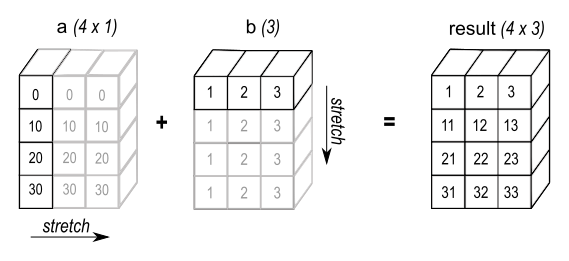
- Batching — Tutorial in SciPy
- Efficiently solve many of the same problem at once
- Common example: NumPy broadcasting operations
Iterative Linear Solvers (1/2)
- Focused my scope in on the iterative solvers
- Solving a linear system \(A x = b\) for \(x\)
- In the batched context, you can have many \(A\) and many \(b\)
- The system may be sparse:
- \(A\) has few nonzero entries => represent in a specialised sparse data structure
- \(A\) may not be represented by its concrete elements, but rather in terms of its matrix-vector product function
Iterative Linear Solvers (2/2)
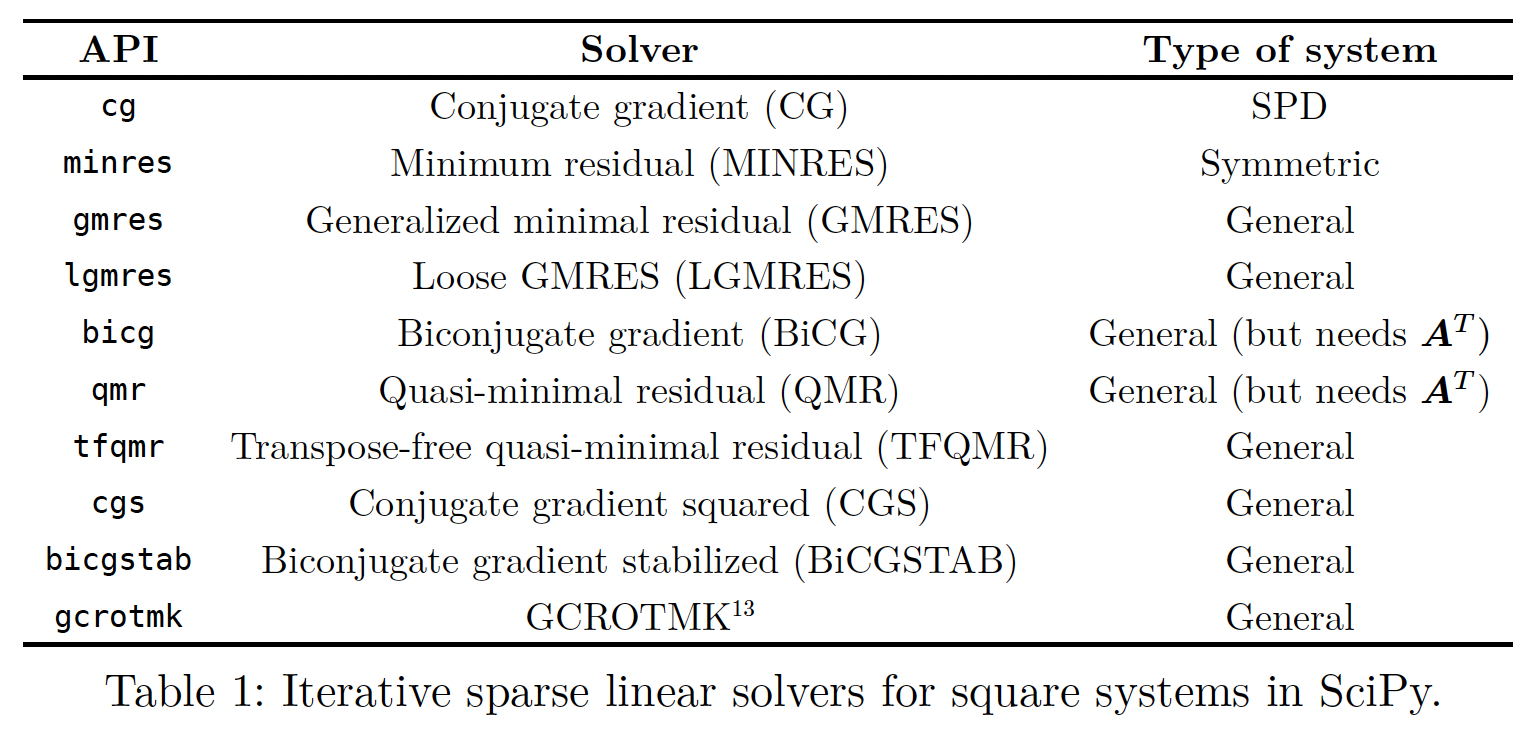
- Iterative solvers:
- Start with a guess for \(x\)
- Each iteration, they do some computation to better approximate \(x\)
Enter LinearOperator
- Before the solver algorithms gain this support, we need the underlying data structure to gain support
- Naïvely, I thought that this would be just a quick first step!
scipy.sparse.linalg.LinearOperatoris the data structure used by these algorithms
What is a LinearOperator?
The Linear Operator data structure
- An abstraction over matrix-like objects in \(\mathbb{C}^{m \times n}\)
- Has associated multiplication functions:
- matrix-vector
- matrix-matrix
- Transposition, composition, summation, scalar multiplication, and exponentiation to integral powers all yield a new Linear Operator
LinearOperator
scipy.sparse.linalg.LinearOperator- Originally contributed 18 years ago!
scipy.sparse.linalg.aslinearoperatorcan convert dense or sparse arrays to aLinearOperator- Can also be constructed from a user-supplied
matveccallable, or via subclassing - Has
matvecandmatmatmultiplication methods- Various other methods and attributes
Requirements
- Enable:
- representing batches of operators in \(\mathbb{C}^{B \times m \times n}\)
- using alternative array types for I/O and computation
- Requires:
- removing assumptions of 2-D data
- generalising NumPy operations to use the array API
- Without breaking the world!
Enhancement Process
Getting Started
- Opened a draft PR on October 22nd 2025
- Prototype already working for some examples!
- But this was just the beginning…
Input/Output
- Stop hardcoding
ndim = 2 - Refer to the last two dimensions instead of the first two:
xp arrays
- some simple swaps:
Batched Computation (1/2)
- We follow standard NumPy broadcasting rules when combining batches of input
Batched Computation (2/2)
- Use
...indexing to allow arbitrary batch dimensions to pass through:
Challenges: backwards-compatibility
- However: code written against the old implementation must not be broken when upgrading to the new implementation
- This forces us to still iterate through columns here, in case matvec does not support batched computation:
Challenges: pickle-ability (1/2)
- While not explicitly documented, another backwards-compatibility constraint is that
pickleshould continue to work onLinearOperatorobjects. - Our test-suite caught this!
Challenges: pickle-ability (2/2)
- Modules (like
nporself._xp) cannot be pickled, so we instead tell pickle how to represent the state with an array (self._xp.empty(0)), and recoverself._xp:
Challenges: poor documentation
- The documentation was not great — both user-facing and developer-facing!
- A lot of my time was spent trying to get in the heads of whoever wrote the code, to understand what their intentions were
- More docstrings and comments would have been very helpful!
Challenges: bad decisions?
matvecpromised to accept \(1\)-dimensional vectors not only in row-vector format (shape(n,)), but also in column-vector format (shape(n, 1))- Seemingly for convenience
- But keeping this with batch dimensions would introduce complexity and ambiguity…
Challenges: deprecation
- … so it was decided to deprecate support for the column-vector format, moving towards a clearer API where
matvecoperates on (batches of) row vectors - SciPy policy: emit a
DeprecationWarningfor 2 minor releases (~1 year) before removal
We got there eventually!

- PR merged with only 248 comments :)
- 4 months of iterating
- improving tests and docs
- fixing bugs
What did we learn?
Established code can be ‘bad’
- Sometimes a small prototype can end up becoming the de facto standard as a historical accident!
- Incremental improvements are not always well thought out
- Inconsistencies can arise, when changes are made to one part of the interface but not another
Backwards-compatibility is very important
- Probably, there are a lot more people hoping that existing functionality will keep working than are waiting for whatever you are adding!
- But: exactly what respecting backwards-compatibility means can be a judgement call
- It required surprisingly careful attention to determine what the implicit contract was between the API and its users
Refactoring can be useful
- Careful refactoring can help a lot!
- Reducing code duplication and factoring out common functionality can help catch bugs and ensure behaviour is consistent
Testing is crucial (1/2)
- Some bugs evaded me for a while
- e.g. incorrect broadcasting behaviour for edge cases like empty arrays
- For big changes, don’t just get the existing tests passing — figure out what tests are missing
Testing is crucial (2/2)
- Pre-existing tests were focused around a few particular cases with hardcoded numbers
- PR adding a whole new style of tests
- More systematic
- Using random data
- Making heavy use of
pytest.mark.parametrizeover dtypes, shapes etc.
Write good documentation
- For users, for yourself, and for future developers
- Force yourself to explain what the interface is promising users, and how that is achieved
Finally: don’t underestimate the ‘easy’ work
- Deadlines on research put pressure on you to get working prototypes and results
- Creating solid foundations which can be re-used by others may entail a big time commitment
- But if you have the time, go for it!
With thanks to:
- all reviewers involved in the PRs discussed in this talk!
- especially Matt Haberland
- Patrick J. Roddy for this Quarto talk template
- the EuroSciPy 2026 organisers and volunteers
- everyone for your attention!
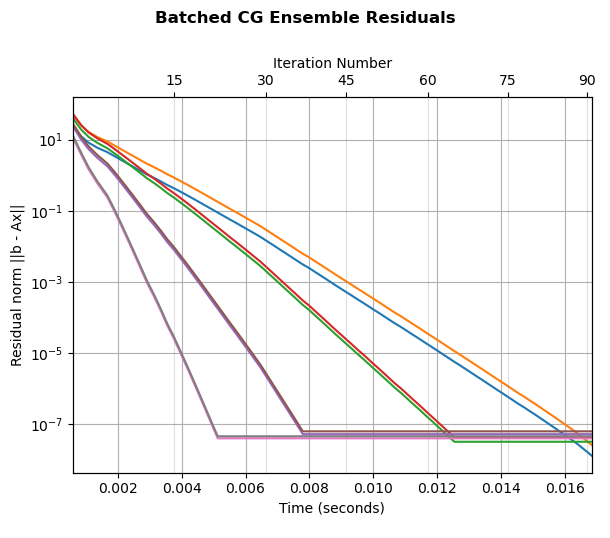
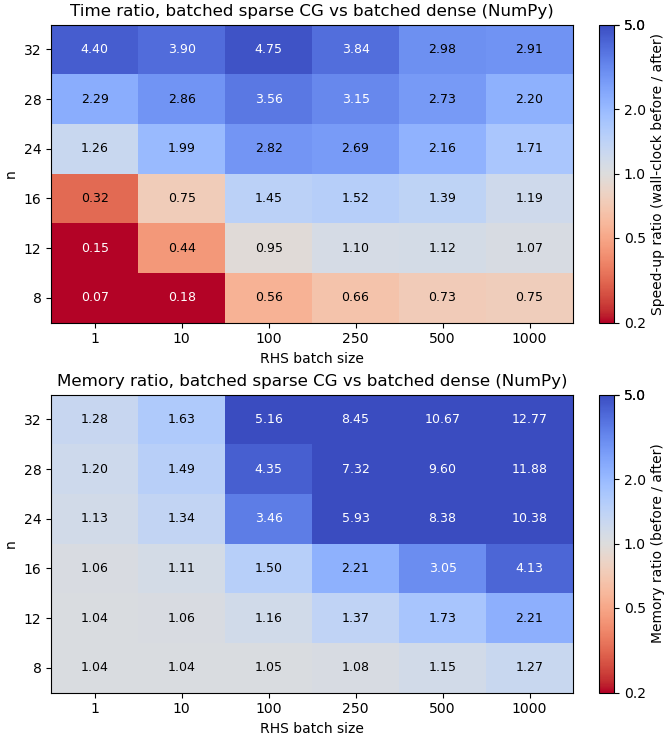
Bonus: using the enhancements! (1)
Bonus: using the enhancements! (2)
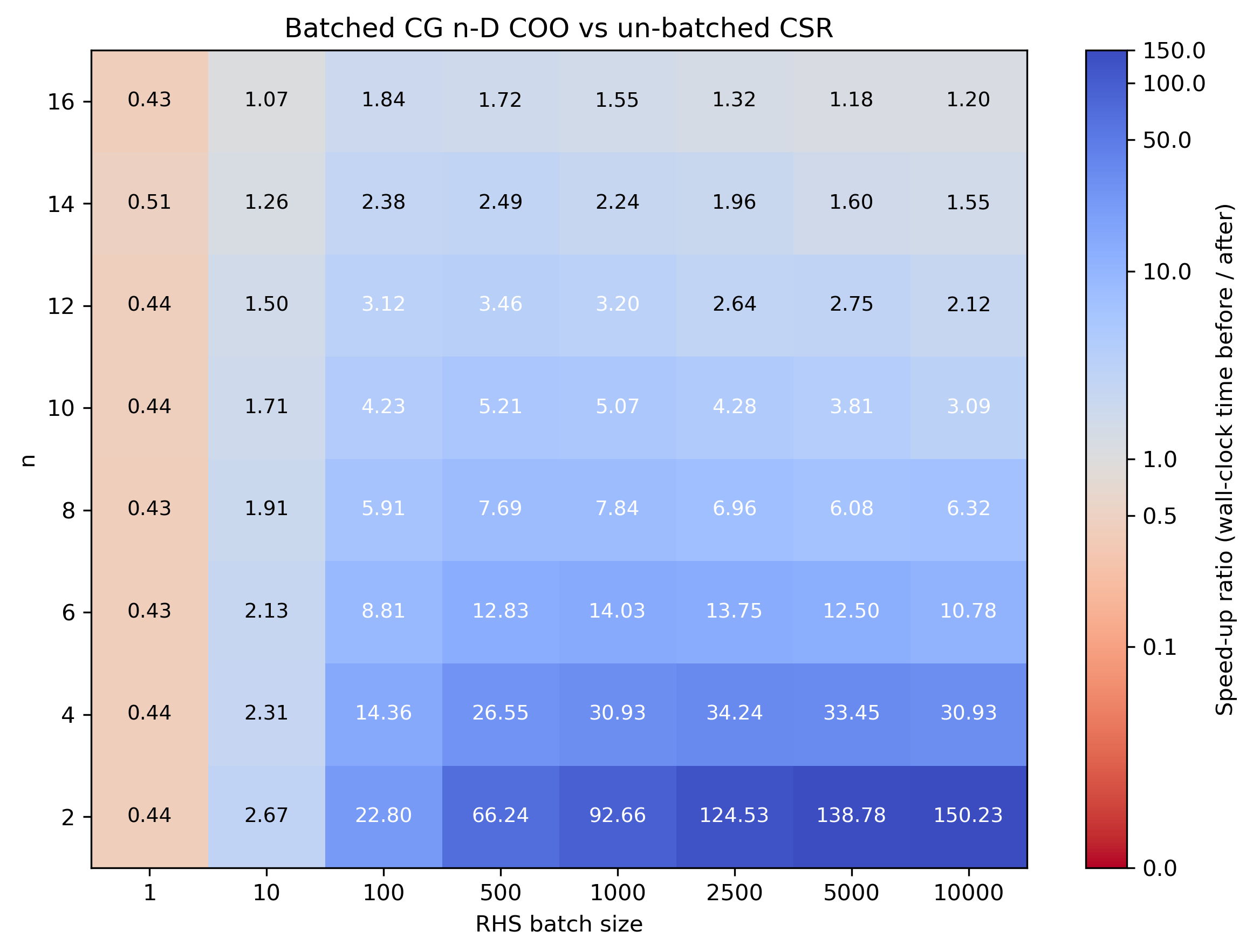
Bonus: using the enhancements! (3)
LinearOperator: stories from advancing an 18-year-old data structure in SciPy - https://lucascolley.github.io/talks